From Local Petition to Public Programme: How the Policy Cycle Took Shape
The policy cycle helps rural readers see how a local concern can enter public debate, shape decisions and return for revision without following a tidy line.
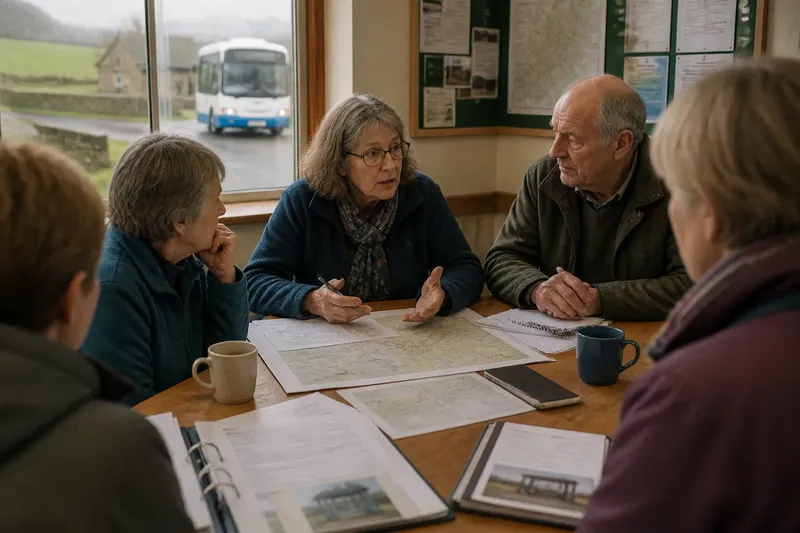
A petition about an unreliable rural bus service can begin at a parish meeting, reach a council committee and end up folded into a transport plan. The policy cycle offers a useful way to read that journey: it names recurring stages of public decision-making, but it does not promise that events will follow them in order.
Its value is less like a railway timetable and more like a map with familiar landmarks. For residents, councillors and service staff, the distinction matters: a concern may be waiting for attention, competing over options, or being judged after a programme has begun.
Why did people start describing policy as a cycle?
Public decisions have always involved more than a single vote. A community raises a concern; officials and elected representatives decide whether it merits action; they weigh possible responses; money and authority are assigned; and somebody eventually asks whether the intervention worked as intended. Political scientists and public administrators began using staged models to make those recurring activities easier to describe and study.
There is no single inventor or definitive version of the policy cycle. Different accounts divide the work differently, but many include agenda-setting, policy formulation, adoption, implementation and evaluation. Some separate consultation or problem definition; others treat those as part of the surrounding stages.
The cycle metaphor makes one important point: evaluation can send an issue back into debate. A programme might be revised, expanded, replaced or allowed to end. This is different from a simple sequence in which a decision is made once and then left alone.
What does each stage help you notice?
Think of a rural concern such as a lack of accessible transport to a health centre. The stages are not boxes that must be ticked in order. They are questions that help identify where public attention and responsibility currently sit.
- Agenda-setting: Has the concern become visible to people with authority to act? A petition, service complaint, local meeting or council motion may help put it on the agenda, but attention can also come from a service disruption or a change in local need.
- Formulation: What responses are being considered, and who is shaping them? Options might include changing a route, arranging a demand-responsive service or coordinating with an existing provider. The policy-cycle point is that defining the problem and choosing a response are connected, not interchangeable.
- Adoption: Who has the authority to approve a course of action? A council decision, departmental plan or funding agreement may give a proposal formal standing. A popular idea can still stall if the relevant body lacks the power or resources to adopt it.
- Implementation: Who turns the decision into a working arrangement? A policy may depend on transport staff, contracted operators, local facilities or cooperation between public bodies. The difference between an approved proposal and a service people can use often appears here.
- Evaluation: What signs indicate whether the arrangement is meeting its purpose? Residents and decision-makers might look at whether people can reach appointments, whether the service is accessible and whether the timetable fits local journeys. Evaluation can uncover a new problem rather than provide a simple verdict.
These labels are most useful when they clarify a practical question. If a petition has received a polite acknowledgement but no decision-maker has accepted responsibility, the main gap may be agenda-setting. If a plan exists but nobody can explain who will deliver it, implementation deserves attention.
Which part of the cycle fits your situation?
If you are a resident trying to make a concern legible, focus on the decision point rather than using the stage names as a test. A concise account of the problem, who is affected and which public body may have authority can help an issue travel from local discussion into formal consideration.
If you are an elected member or community representative, ask what information is missing before pressing for a particular solution. A petition may reveal a real difficulty without establishing whether the cause is a route, a timetable, accessibility, coordination or a wider service gap. Keeping those questions open can prevent the first proposed remedy from closing down useful discussion.
If you work in a public service, look for the hand-off between approval and delivery. A programme can be formally adopted while responsibilities, communication or links with existing services remain unclear. Naming those gaps helps distinguish a policy decision from the arrangements needed to carry it out.
Say a fictional village group petitions its council because residents cannot reach a health centre by bus at suitable times. The council refers the issue to its transport team, which asks residents and the provider about journey needs before considering timetable changes. The expected observable result is not a predetermined policy outcome, but a clearer public record of who is assessing the issue, which options are under consideration and when the next decision will be made.
For anyone following a programme already under way, look for feedback that can alter the decision. If residents describe a service as inaccessible, that information should be treated as a possible reason to revisit the design, not merely as a comment to file after implementation.
Why does the real process refuse to stay in order?
Public problems rarely arrive with a settled definition. A petition may describe a transport shortage; service staff may identify a coordination problem; elected members may see a question of access to health care. Each account can point towards different remedies, so debate about the problem may continue while officials are already testing possible responses.
Authority is often distributed, especially in rural areas where a service can involve a local council, a regional body, a public provider and a contracted operator. One organisation may identify the need, another control funding, and another deliver the service. The stages can therefore overlap or pause while responsibility is negotiated.
Events also reshape priorities. A change in provider, new local evidence or a shift in available public resources may return an issue to the agenda after a programme has begun. That is not necessarily a failure of orderly administration; it may be the point at which decision-makers recognise that earlier assumptions no longer fit.
The cycle can also hide power if readers treat every stage as neutral. Some concerns receive attention quickly, while others struggle to reach the rooms where options are formed. Asking who gets heard, who defines the problem and whose experience counts makes the model more revealing than simply labelling a process “consultation” or “evaluation”.
What do readers often ask about the policy cycle?
Is the policy cycle a formal rule?
No. It is an analytical model used to describe recurring kinds of public decision-making, not a required procedure that every government must follow. The formal rules depend on the institution and the kind of decision.
Does every policy begin with a petition?
No. Petitions are one way for a concern to gain attention, alongside public meetings, service feedback, elected representatives and administrative reviews. An issue may already be on an agency’s agenda before residents organise around it.
Where does consultation fit in the cycle?
Consultation can inform problem definition, the comparison of options, implementation or evaluation. Its place depends on what decision is open and whether people’s input can still affect it.
What happens after evaluation?
Decision-makers may continue, alter, expand, replace or end a programme, depending on the purpose and what they learn. The evaluation may also reveal a different problem that needs attention.
When is the cycle useful, and when is it not?
Use the policy cycle when you need to locate a decision, identify a missing hand-off or explain why a public concern has not yet become a working programme. Its simple vocabulary can help a resident ask whether an issue is being considered, a response chosen, a decision authorised or delivery reviewed.
Do not expect it to explain every conflict or predict what officials will do next. It cannot, by itself, tell you which option is fair, whether a particular body has legal authority, or why one concern receives attention ahead of another. Those questions require attention to local institutions, evidence, public priorities and the people affected.
It is not worth forcing every conversation into a stage label. A resident describing a missed connection does not need to call it an implementation issue before being heard; clear details about the journey and its consequences are more useful. The model should sharpen understanding, not turn ordinary public discussion into a vocabulary test.
For a rural reader, the lasting use of the policy cycle is a better question at each point: who can act, what choice is genuinely open, who will deliver it, and how will people know if it needs to change? That is how a local petition can remain connected to public decisions long after the first meeting has ended.